
- Home
- No-Code&Low-Code
- Relay
Relay
Open Website-
Tool Introduction:Build AI agents for 100+ apps to automate workflows, with human review.
-
Inclusion Date:Oct 28, 2025
-
Social Media & Email:


Tool Information
What is Relay AI
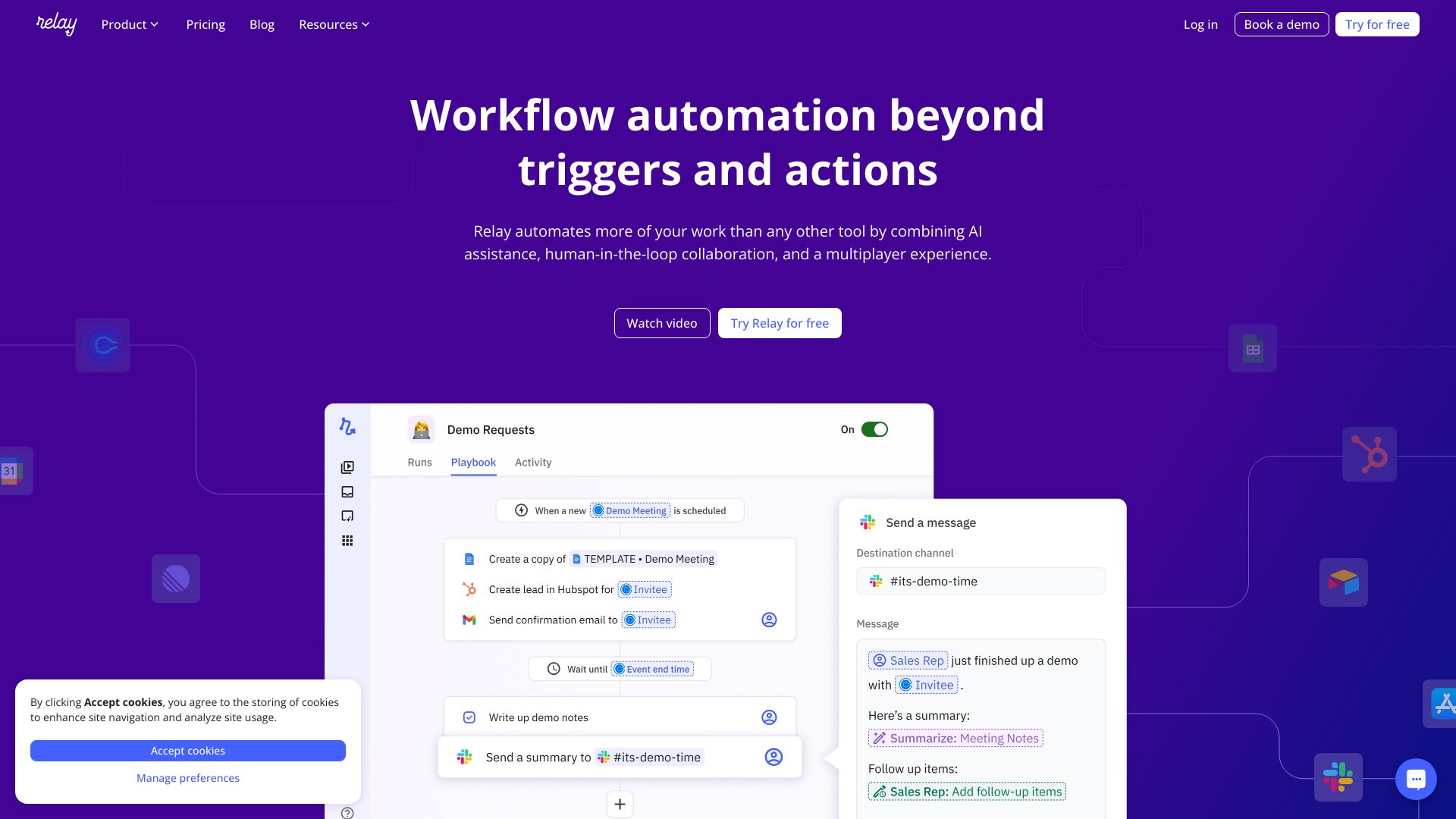
Relay AI is a platform for creating practical AI agents that automate work across 100+ business apps. Going beyond brittle trigger–action chains, it combines a visual workflow builder with one-click AI assistance, enabling agents to read context, choose next steps, and take actions in tools like Gmail, Slack, and Notion. With human-in-the-loop reviews and a multiplayer collaboration model, teams can co-design, approve, and monitor automations to scale routine tasks while preserving control, transparency, and reliable outcomes.
Relay AI Key Features
- AI agent workflows: Build agentic workflows that understand context, branch intelligently, and make decisions instead of following rigid triggers only.
- 100+ app integrations: Connect Gmail, Slack, Notion, and other popular SaaS tools in minutes to read data, create records, send messages, and update systems.
- One-click AI assistance: Use AI to draft emails, summarize threads, extract fields, classify content, and fill steps with smart defaults to speed up build time.
- Human-in-the-loop control: Insert approval and review gates so people can validate AI outputs, edit drafts, or re-route exceptions before actions are taken.
- Multiplayer collaboration: Co-build workflows, assign reviews, and track runs together, making automation a shared team process instead of a solo task.
- Reusable components: Save prompts, steps, and patterns as building blocks so teams can standardize processes and scale best practices.
- Observability and audit trails: Monitor runs with logs, outcomes, and handoffs to maintain accountability and improve reliability over time.
- Flexible logic: Combine AI steps with rules, conditions, and data mapping to balance determinism with AI-powered reasoning.
Who should use Relay AI
Relay AI suits operations teams, customer support, sales, marketing, HR, and founders who want reliable AI workflow automation across everyday tools. it's helpful for no-code builders who need fast integrations and for technical teams seeking human-in-the-loop guardrails, collaborative reviews, and agentic decisions that go beyond simple triggers and actions.
How to use Relay AI
- Sign up and create a workspace for your team.
- Connect the apps your agents will use (e.g., Gmail, Slack, Notion) and grant the necessary permissions.
- Create a new workflow and define its goal or the event that should start it.
- Add AI steps to analyze context, extract fields, summarize content, or draft messages, alongside rules-based steps.
- Insert human-in-the-loop approvals where you want people to review, edit, or approve outputs.
- Map actions to your connected apps to send messages, create docs, update records, or route tasks.
- Test the workflow with sample data, refine prompts and conditions, then enable it for production runs.
- Monitor executions, review logs, and iterate to improve reliability and throughput.
Relay AI Industry Use Cases
Sales: Capture inbound leads from Gmail, enrich details, create CRM entries, draft outreach, and notify owners in Slack for approval.
Customer support: Triage messages, summarize conversations, propose replies, and escalate edge cases for human review before sending.
Content operations: Gather briefs from Notion, generate drafts, request edits from stakeholders, and publish when approved.
Recruiting: Parse resumes from email, score candidates against role criteria, create profiles in Notion, and coordinate interviews via Slack.
Relay AI Pros and Cons
Pros:
- Agentic workflows that go beyond basic trigger–action automations.
- Fast integrations with Gmail, Slack, Notion, and 100+ other apps.
- Human-in-the-loop approvals provide control and quality assurance.
- Multiplayer collaboration enables shared ownership and transparency.
- Clear logs and reviews to monitor outcomes and improve reliability.
Cons:
- Complex workflows may require iteration to tune prompts and logic.
- Dependent on third-party app permissions, API limits, and quotas.
- AI steps can be non-deterministic and may need human review for edge cases.
- Teams must design privacy and data handling policies across connected apps.
Relay AI FAQs
-
How is Relay AI different from traditional automation tools?
It adds agentic reasoning, one-click AI assistance, and human-in-the-loop reviews to extend beyond simple triggers and actions, while still integrating with 100+ apps.
-
Do I need to code to build workflows?
No. Relay AI offers a visual builder for no-code automation, while still allowing teams to combine AI steps with rules and structured logic.
-
Which apps does Relay AI support?
It connects to Gmail, Slack, Notion, and many other popular SaaS tools, enabling agents to read data, draft content, and take actions across systems.
-
Can I require approvals before actions are taken?
Yes. Insert human-in-the-loop steps so reviewers can edit or approve outputs before messages are sent or records are updated.
-
Is it suitable for teams?
Yes. Multiplayer collaboration lets multiple stakeholders co-build, review, and monitor automations with shared visibility and audit trails.