
- Home
- AI App Builder
- Anyscale
Anyscale
Open Website-
Tool Introduction:Build, run, and scale AI apps fast with Ray. Cut costs on any cloud.
-
Inclusion Date:Nov 09, 2025
-
Social Media & Email:


Tool Information
What is Anyscale AI
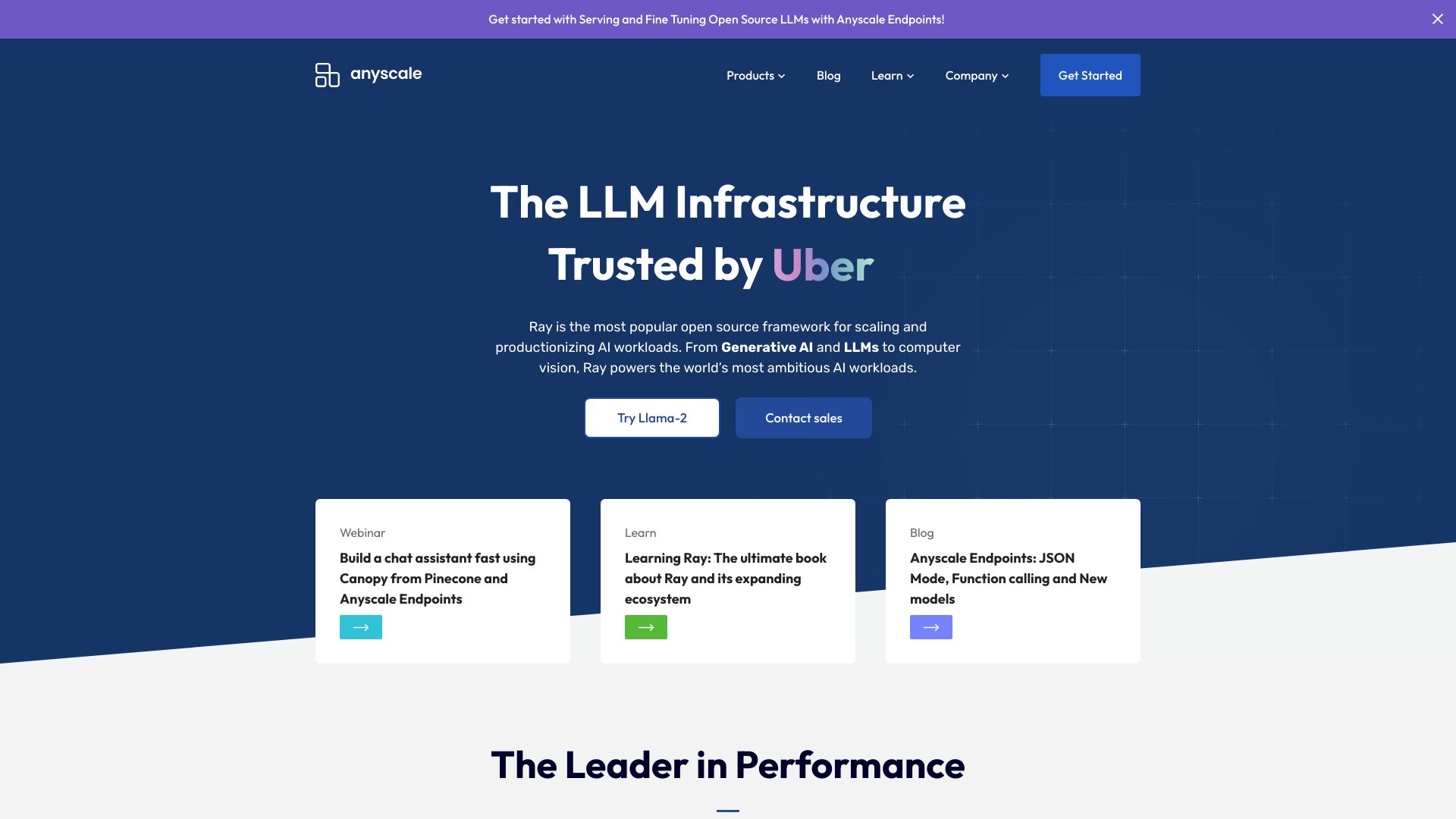
Anyscale AI is an AI application platform built on Ray, the open-source distributed computing framework. It helps teams build, run, and scale AI and Python workloads—such as LLM applications, model serving, fine-tuning, and batch inference—without heavy infrastructure management. With serverless Ray, autoscaling across CPUs and GPUs, and robust governance, Anyscale improves performance and cost efficiency on any cloud. Developers get unified tooling for deployment, observability, and lifecycle management, plus OpenAI-compatible endpoints and flexibility for any framework, accelerator, or stack.
Main Features of Anyscale AI
- Serverless Ray: Run distributed training, inference, and pipelines without provisioning or tuning clusters manually.
- LLM and model endpoints: OpenAI-compatible APIs for serving foundation models or your own fine-tuned models.
- Autoscaling and scheduling: Scale up and down across CPUs, GPUs, and accelerators based on workload demand.
- Cost optimization: Spot/priority instances, placement policies, and right-sizing to reduce AI infrastructure spend.
- Governance and security: RBAC, service accounts, cluster policies, audit logs, and VPC connectivity for controlled access.
- Observability: Centralized logs, metrics, traces, and cluster health to debug and monitor AI applications.
- Any cloud and stack: Deploy across clouds and integrate Python, PyTorch, TensorFlow, Hugging Face, and more.
- Developer tooling: SDKs and CLI for submitting Ray jobs, managing services, CI/CD integration, and reproducible deployments.
- Batch and streaming: Efficient distributed batch inference, data processing, and real-time serving patterns.
- Experimentation and evaluation: A/B testing, rollouts, and evaluation workflows to compare models and configs.
Who Can Use Anyscale AI
Anyscale AI is designed for software engineers, ML engineers, data scientists, and MLOps teams who need to scale LLMs and AI workloads reliably. Platform and DevOps teams use it to standardize compute governance and security across clouds. It also fits startups building AI features quickly, research labs running large experiments, and enterprises that require multi-cloud flexibility, cost control, and production-grade observability for AI services.
How to Use Anyscale AI
- Sign up and create a workspace; connect your cloud account or choose serverless execution.
- Install the SDK/CLI and configure authentication, project, and environment variables.
- Choose a path: deploy model endpoints for serving, or submit Ray jobs/services for custom pipelines.
- Select models (hosted or bring-your-own) and define dependencies via requirements files or images.
- Configure compute: CPU/GPU types, accelerators, autoscaling policies, and cluster governance rules.
- Deploy from the CLI or CI/CD; integrate your app via HTTP API or SDK.
- Monitor logs, metrics, and traces; set alerts and budgets to manage reliability and cost.
- Iterate: tune resources, update models, A/B test versions, and roll out safely.
Anyscale AI Use Cases
Organizations use Anyscale AI for production LLM chatbots and copilots, retrieval-augmented generation (RAG), high-throughput batch inference, and fine-tuning or supervised training at scale. In finance, teams run large backtesting and risk simulations. E-commerce firms power recommendation and personalization services. Media companies handle content moderation and transcription. Healthcare and biotech run secure model serving and large experiments with governance and observability.
Anyscale AI Pricing
Anyscale AI typically follows a usage-based pricing model. Costs reflect consumed compute (CPU/GPU hours, storage, networking) for Ray workloads, and per-request or token-based pricing for hosted model endpoints. Self-serve and enterprise plans are available, with volume discounts and custom support for larger deployments. For current rates, quotas, and SLAs, refer to the official pricing page or contact the sales team.
Pros and Cons of Anyscale AI
Pros:
- Scales AI and Python workloads efficiently with serverless Ray.
- OpenAI-compatible endpoints simplify app integration.
- Strong governance, RBAC, and observability for production.
- Multi-cloud and accelerator flexibility to avoid lock-in.
- Cost controls and autoscaling reduce infrastructure spend.
Cons:
- Learning curve for Ray concepts (tasks, actors, distributed patterns).
- Complex workloads may require careful tuning to hit SLOs.
- GPU-heavy use can become costly without strict policies.
- Enterprise setup (VPCs, IAM, network policies) requires coordination.
- Migrating legacy pipelines to Ray may take engineering effort.
FAQs about Anyscale AI
-
What is Ray and why does Anyscale use it?
Ray is an open-source framework for distributed computing. Anyscale uses Ray to parallelize AI workloads, enabling scalable training, serving, and batch processing with minimal code changes.
-
Does Anyscale AI offer OpenAI-compatible APIs?
Yes. Anyscale provides endpoints with OpenAI-compatible interfaces, so existing clients can integrate with minimal changes.
-
Can I bring my own cloud and VPC?
Yes. You can connect your cloud account and run in your VPC with governance controls, or use fully managed serverless execution.
-
Which frameworks and models are supported?
Anyscale supports common AI stacks including Python, PyTorch, TensorFlow, and Hugging Face, plus hosted and custom models.
-
How do I control costs?
Use autoscaling, spot instances where appropriate, resource quotas, budgets, and observability to track utilization and optimize spend.