
- Home
- AI Customer Service
- Serviceaide
Serviceaide
Open Website-
Tool Introduction:Serviceaide: AI enterprise service management and automation
-
Inclusion Date:Nov 09, 2025
-
Social Media & Email:


Tool Information
What is Serviceaide
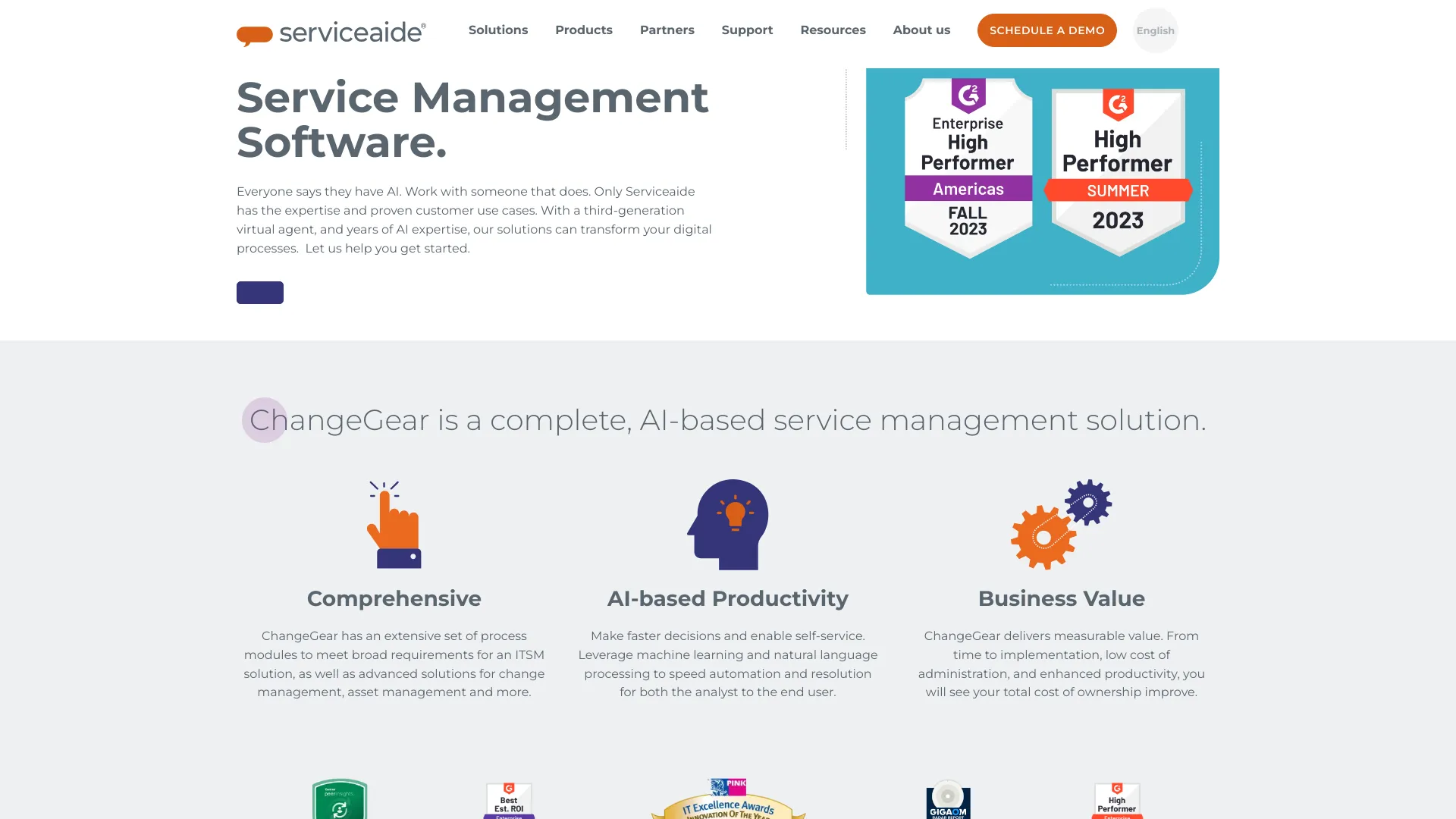
Serviceaide is an AI-powered platform for enterprise service and digital service management. It streamlines operations with intelligent automation, virtual agents, and knowledge-driven workflows that reduce ticket volume and accelerate resolution. Through products such as DSMLuma AI and AISM, Serviceaide enables omnichannel self-service, natural language interactions, and end‑to‑end process orchestration. Teams across IT, HR, facilities, and customer support use it to improve productivity, consistency, and user experience at scale.
Main Features of Serviceaide
- AI virtual agent: Conversational self-service that understands intents, answers questions, and fulfills requests across chat, web, and collaboration tools.
- Digital service management: Unified portal and catalog for incident, request, change, and problem management with SLAs and approvals.
- Knowledge automation: AI-driven knowledge capture, suggestions, and deflection to reduce repetitive tickets.
- Workflow orchestration: No-code automation to route, trigger tasks, and integrate with enterprise systems and ITSM tools.
- Omnichannel support: Serve users in channels like web chat, email, and collaboration apps with consistent responses.
- Analytics and reporting: Dashboards for CSAT, MTTR, deflection, and service performance to guide continuous improvement.
- Context and personalization: Leverages profiles, roles, and historical activity for accurate, policy-aware answers.
- Enterprise governance: Role-based access, audit trails, and compliance features for regulated environments.
- Multilingual capabilities: Support for global teams and distributed service desks.
Who Can Use Serviceaide
Serviceaide suits IT service desks, HR service delivery, facilities and operations teams, and customer support organizations aiming to scale self-service and automate routine work. It is valuable for mid-size and enterprise companies, shared service centers, and managed service providers seeking AI service management, ticket deflection, and streamlined request fulfillment across departments.
How to Use Serviceaide
- Sign up for a demo or trial and select modules, including DSMLuma AI and AISM capabilities.
- Connect channels such as web portal, chat, email, or collaboration apps for omnichannel self-service.
- Import or author knowledge articles and map common intents, FAQs, and service catalog items.
- Configure workflows, SLAs, approvals, and automations for incident, request, and change processes.
- Integrate with directories and business systems to enable data-driven, policy-aware responses.
- Train the virtual agent with example phrases and test conversations to improve accuracy.
- Publish the service portal and virtual agent to target user groups and collect feedback.
- Monitor analytics, tune knowledge, and iterate workflows to boost deflection and resolution speed.
Serviceaide Use Cases
IT teams use Serviceaide to automate password resets, software requests, and incident triage. HR service delivery handles onboarding, benefits queries, and policy guidance via the virtual agent. Facilities teams route maintenance requests and approvals. In industries such as healthcare, financial services, education, and manufacturing, organizations apply AI service management for compliance-aware knowledge access, field support coordination, and employee self-service at scale.
Serviceaide Pricing
Serviceaide typically offers modular, subscription-based pricing that varies by selected products (such as DSMLuma AI and AISM), number of users or agents, and conversation or automation volume. Enterprise packages and add-ons for integrations and compliance may be available. A guided demo and pilot options are commonly provided to help teams validate value and scope deployment.
Pros and Cons of Serviceaide
Pros:
- AI-driven self-service reduces ticket volume and speeds resolution.
- Unified digital service management across multiple departments.
- No-code automation and strong workflow orchestration.
- Robust knowledge management and intent recognition.
- Analytics for continuous service improvement.
Cons:
- Implementation and integration require planning and stakeholder alignment.
- Quality of results depends on knowledge base coverage and training data.
- Advanced features may be more than small teams need.
- Change management is necessary to drive adoption of new processes.
FAQs about Serviceaide
Does Serviceaide integrate with existing ITSM and business tools?
Yes. It supports integrations to synchronize tickets, users, assets, and workflows with common enterprise systems.
Can the virtual agent handle end-to-end fulfillment?
It can trigger automated workflows, gather approvals, and update records to complete many requests without human intervention.
Is it suitable for non-IT departments?
Yes. HR, facilities, finance, and customer operations use it for digital service management and self-service.
How long does deployment take?
Timelines vary by scope, but teams often start with a focused use case, then expand as knowledge and automations mature.
Does it support multilingual experiences?
Serviceaide provides multilingual capabilities to serve global user bases across channels.