
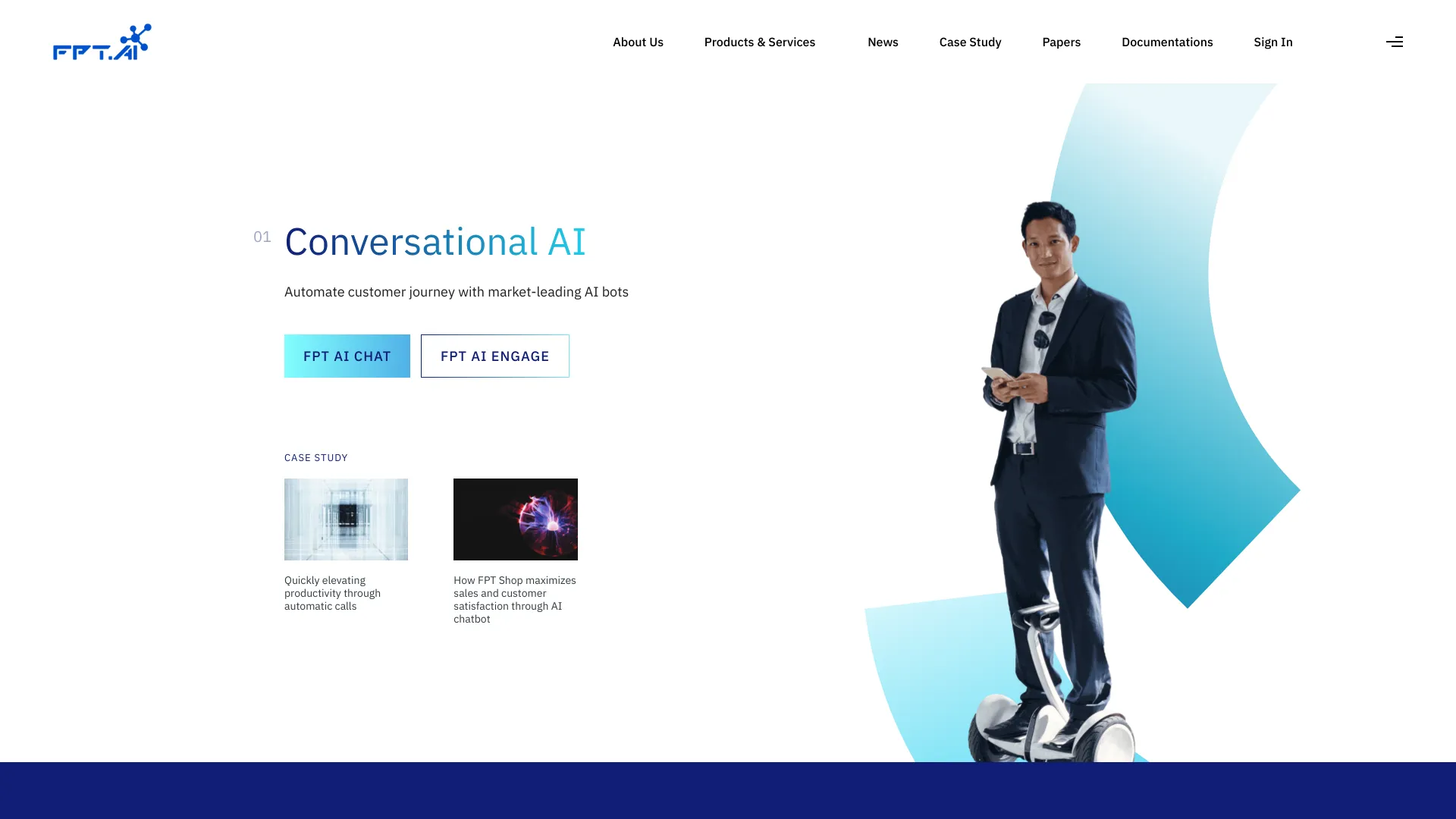
FPT AI
Open Website-
Tool Introduction:All-in-one enterprise AI for chatbots, document automation, CX.
-
Inclusion Date:Oct 28, 2025
-
Social Media & Email:


Tool Information
What is FPT AI
FPT.AI is a comprehensive enterprise AI platform that helps organizations become AI-first by embedding intelligent automation across customer service, operations, and sales. It brings together conversational AI for building chatbots and voicebots, document processing powered by OCR and NLP, and orchestration tools to integrate AI into existing workflows. With APIs, analytics, and human-in-the-loop capabilities, FPT.AI enables teams to design, deploy, and scale AI solutions that improve customer experience, reduce manual work, and accelerate digital transformation.
FPT AI Main Features
- Conversational AI Suite: Build and manage chatbots and voicebots with NLU, intent detection, and dialog management across web, mobile, and contact center channels.
- Document Processing: OCR + NLP to capture and extract data from invoices, forms, IDs, and contracts with validation flows and confidence scoring.
- Workflow Orchestration: Connect AI outputs to business systems via APIs, triggers, and rules to automate end-to-end processes.
- Analytics and Quality Monitoring: Dashboards for conversation metrics, extraction accuracy, SLAs, and continuous improvement insights.
- Human-in-the-Loop: Seamless handoff to agents and reviewer queues to verify fields, correct errors, and train models over time.
- Integration & Extensibility: API-first architecture, SDKs, and connectors to CRMs, ticketing tools, and data stores.
- Model Lifecycle Management: Dataset curation, versioning, evaluation, and controlled rollout for reliable production performance.
- Security & Governance: Role-based access controls, audit trails, and environment separation to support enterprise adoption.
FPT AI Who Is It For
FPT.AI suits enterprises and fast-growing organizations looking to modernize customer experience and operations. Typical users include customer service and contact center teams, operations leaders, sales enablement and e-commerce managers, IT and integration engineers, and data/automation teams across banking, insurance, retail, telecom, logistics, healthcare, and the public sector.
FPT AI How to Use
- Define the business objective and KPIs (e.g., reduce call volume, automate invoice capture, speed up onboarding).
- Create a workspace and select products such as Conversational AI or Document Processing.
- Import data (utterances, forms, sample documents) and configure intents, entities, or extraction fields.
- Design workflows: dialog paths, validation steps, escalation rules, and integrations with existing systems.
- Train and test models in a staging environment; run accuracy and usability checks.
- Integrate via APIs/SDKs into websites, mobile apps, contact centers, or back-office pipelines.
- Deploy to production with access controls and monitoring enabled.
- Review analytics, collect feedback, and iterate on models and flows for continuous improvement.
FPT AI Industry Use Cases
Financial institutions automate KYC by extracting data from IDs and forms, reducing manual verification time. Retail and e-commerce deploy chatbots for order status, returns, and promotions, deflecting repetitive inquiries. Telecom providers use voicebots for outage updates and plan changes. Logistics teams process bills of lading and delivery notes at scale, cutting data-entry errors and accelerating billing cycles.
FPT AI Pricing
Pricing is typically provided through direct consultation and depends on products used, deployment scope, and usage volumes. Organizations can request a demo and a tailored proposal from the FPT.AI team.
FPT AI Pros and Cons
Pros:
- Unified platform spanning conversational AI, document intelligence, and workflow automation.
- API-first design and integration options that fit complex enterprise environments.
- Human-in-the-loop and analytics features support accuracy and continuous improvement.
- Scalable architecture suitable for high-volume interactions and processing.
- Prebuilt components accelerate time-to-value for common CX and back-office scenarios.
Cons:
- Initial setup and integrations may require cross-team coordination and engineering effort.
- Model performance depends on data quality and ongoing maintenance.
- Change management is needed to align workflows and staff with new AI-driven processes.
- Total cost can scale with transaction volume and advanced feature usage.
FPT AI FAQs
-
What problems does FPT.AI solve?
It streamlines customer interactions and back-office tasks by combining conversational AI with document processing and automated workflows.
-
Does FPT.AI integrate with existing systems?
Yes. The platform offers APIs, SDKs, and connectors to embed AI into CRMs, ticketing tools, and data pipelines.
-
Can non-technical teams use it?
Business users can configure dialogs and validation steps via visual builders, while technical teams handle integrations and governance.
-
What languages are supported?
Language availability varies by product and deployment. Check product documentation and roadmap for current support.
-
How is quality monitored?
Dashboards track conversation metrics and extraction accuracy, while human review and retraining help improve outcomes over time.