
- Home
- AI App Builder
- Flatlogic
Flatlogic
Open Website-
Tool Introduction:AI app builder for SaaS, CRM, ERP—launch full‑stack fast, own your code.
-
Inclusion Date:Nov 08, 2025
-
Social Media & Email:


Tool Information
What is Flatlogic AI
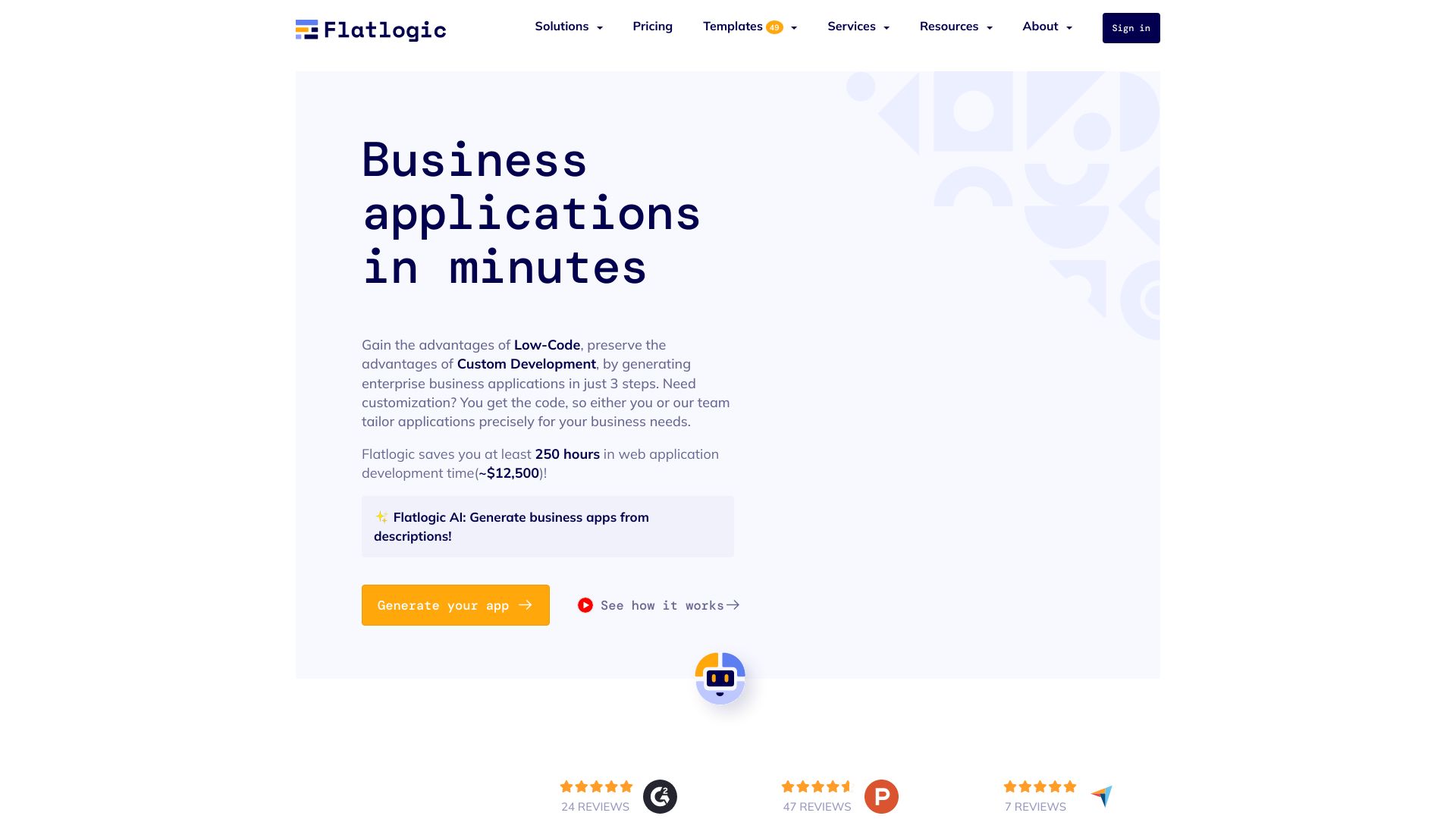
Flatlogic AI is an AI-powered web app development platform that turns plain-English specifications into production-ready, full-stack applications. It helps teams build SaaS products, CRMs, ERPs, and internal tools in days by automating data modeling, API scaffolding, and front-end interfaces. Users retain code ownership, can export to Git, and deploy instantly to the cloud. With support for modern stacks like React, Node.js, and PostgreSQL, Flatlogic AI reduces boilerplate, streamlines delivery, and accelerates time to market.
Main Features of Flatlogic AI
- AI app generator: Create full-stack apps from prompts or structured specs, turning requirements into working code.
- Data model & schema designer: Define entities, relations, and validations; auto-generate database schemas and migrations.
- REST/GraphQL APIs: Automatic CRUD endpoints with pagination, filtering, and sorting for rapid backend setup.
- Production-ready UI: Prebuilt admin panels and responsive screens using modern component libraries.
- Auth and RBAC: Built-in authentication, user management, and role-based access control.
- Code ownership & export: Download source code or sync to GitHub for full customization and control.
- One-click deployment: Deploy to the cloud instantly or self-host on your own infrastructure.
- Template library: Start from SaaS, CRM, ERP, or dashboard templates tailored to business workflows.
- Configurable tech stack: Choose front-end and backend frameworks, database engines, and tooling.
- Documentation generation: Auto-created README and API docs to simplify onboarding and maintenance.
Who Can Use Flatlogic AI
Flatlogic AI serves startup founders, product managers, and software teams that need to launch MVPs or scale B2B applications faster. Agencies use it to deliver client projects efficiently, while enterprises adopt it for custom CRMs, ERP modules, and internal tools. Developers benefit by eliminating boilerplate and keeping full control of the codebase; non-technical stakeholders can contribute through prompts and visual configuration.
How to Use Flatlogic AI
- Sign up and create a new project in the Flatlogic dashboard.
- Describe your app with a prompt or define entities and relations in the data model designer.
- Select your preferred stack (e.g., React front end, Node.js backend, PostgreSQL database) and a suitable template.
- Review the generated schema, API, and UI preview; tweak fields, validations, and roles as needed.
- Generate the codebase and sync it to GitHub or download a zip for local development.
- Configure authentication, environment variables, and integrations with external services.
- Deploy with one click to the cloud or self-host on your own infrastructure.
- Iterate in your IDE, commit changes, and redeploy as your product evolves.
Flatlogic AI Use Cases
Organizations use Flatlogic AI to build SaaS MVPs, custom CRM systems for sales and support teams, and ERP modules for inventory, finance, or procurement. It powers admin dashboards, analytics portals, and customer portals with secure authentication. Operations and data teams create internal tools—such as approvals, ticketing, or catalog management—faster, while maintaining flexibility to extend the code for complex business logic.
Flatlogic AI Pricing
Flatlogic AI typically offers tiered subscription plans for individuals, teams, and enterprises, with higher tiers unlocking advanced features, greater build limits, collaboration, hosting options, and priority support. Enterprise offerings commonly include custom deployment, SLAs, and security reviews. For the latest plan details and any trials available, refer to Flatlogic’s official pricing information.
Pros and Cons of Flatlogic AI
Pros:
- Accelerates delivery of full-stack, production-ready applications.
- Users retain full code ownership with Git export for flexibility.
- Automates data modeling, APIs, and UI to reduce boilerplate work.
- One-click deployment supports fast iteration and continuous delivery.
- Works with modern, widely adopted technologies and patterns.
Cons:
- Generated code may still require refactoring and performance tuning.
- Complex domain logic and unique workflows need manual implementation.
- Learning curve for configuring models, roles, and infrastructure.
- Costs can increase with team size, build limits, or managed hosting.
FAQs about Flatlogic AI
-
What tech stacks does Flatlogic AI support?
It supports modern stacks commonly including React for the front end, Node.js for the backend, and relational databases such as PostgreSQL.
-
Do I own the generated code?
Yes. You can export the full source code or sync to Git for complete control and customization.
-
Is it suitable for production, not just MVPs?
Flatlogic AI generates production-ready scaffolding, which you can extend and harden for long-term use.
-
Can I integrate an existing database?
You can model entities and connect to external data sources; additional configuration may be required for legacy schemas.
-
How is deployment handled?
You can deploy with one click to the cloud or self-host; environment variables and secrets are configurable for different environments.