
- Home
- AI Code Assistant
- Refact
Refact
Open Website-
Tool Introduction:Refact AI: completion, refactor, chat—privacy-first, on‑prem or cloud.
-
Inclusion Date:Nov 08, 2025
-
Social Media & Email:


Tool Information
What is Refact AI
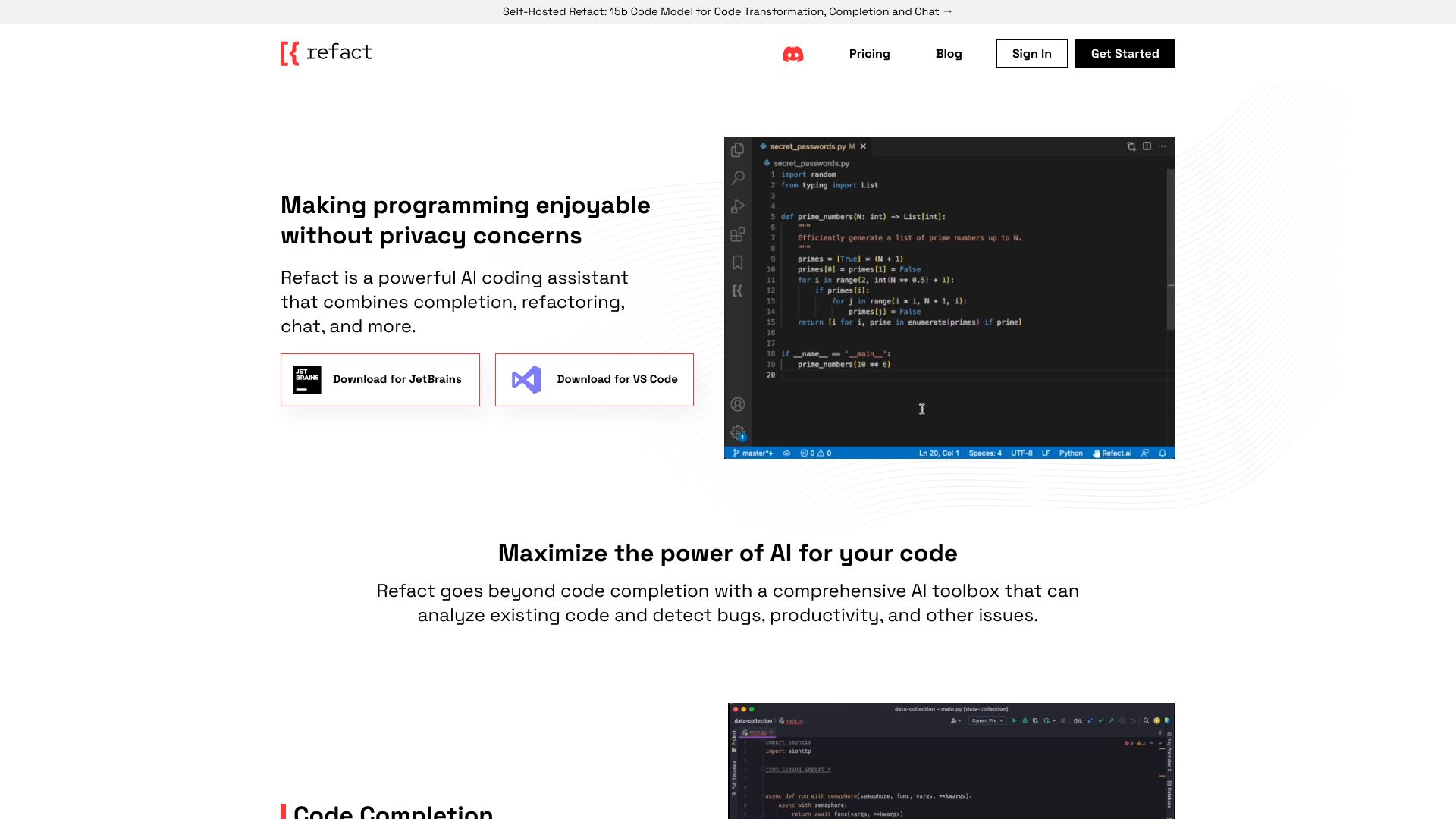
Refact AI is a privacy-first AI coding assistant that brings together code completion, automated refactoring, conversational chat, bug detection, and code analysis to speed up software development. Built for modern teams, it supports major languages and frameworks and lets you restrict access to private code. With flexible cloud or on-premise deployment, Refact AI gives you full control over where your code runs, helping you transform code, catch issues early, and modernize projects without compromising security.
Main Features of Refact AI
- Intelligent code completion: Context-aware suggestions that accelerate typing and reduce boilerplate across popular languages and frameworks.
- Automated refactoring: Safely improve structure, readability, and maintainability with guided refactors tailored to your codebase.
- Chat-based assistance: Ask questions about code, get explanations, and receive step-by-step suggestions within your development workflow.
- Bug detection: Identify potential errors and risky patterns early to reduce defects before code review and testing.
- Code analysis: Understand dependencies, surface smells, and analyze complexity to inform better engineering decisions.
- Code transformation: Modernize syntax, migrate patterns, and streamline updates when upgrading libraries or frameworks.
- Privacy controls: Restrict access to private repositories and configure policies to protect sensitive intellectual property.
- Flexible deployment: Choose cloud or on-premise to maintain full control over data location and compute environment.
Who Can Use Refact AI
Refact AI is ideal for individual developers, growing startups, and enterprise engineering teams that want faster, safer coding. It suits organizations with strict compliance needs—such as finance, healthcare, and government—thanks to on-premise options and granular privacy controls. it's also valuable for teams modernizing legacy systems, accelerating feature delivery, and improving code quality through automated analysis and refactoring.
How to Use Refact AI
- Sign up and create a workspace for your team or project.
- Select your deployment model: cloud for convenience or on-premise for maximum data control.
- Configure privacy settings to restrict access to private code and repositories.
- Open your project and start coding to receive context-aware code completion suggestions.
- Use chat to ask for explanations, best practices, or step-by-step fixes for tricky issues.
- Run refactoring or code transformation actions to improve structure or migrate patterns.
- Review changes, run tests, and commit with confidence after validating suggestions.
Refact AI Use Cases
Development teams use Refact AI to speed up feature delivery with smart autocomplete, streamline large-scale refactoring of legacy code, and perform code analysis to raise code quality. In regulated industries, on-premise deployment supports secure AI-assisted coding without exposing private IP. Product teams use bug detection to reduce regressions, while platform teams leverage code transformation to modernize frameworks and standardize patterns across services.
Pros and Cons of Refact AI
Pros:
- Combines completion, refactoring, chat, bug detection, and analysis in one tool.
- Strong privacy controls with cloud and on-premise deployment options.
- Supports major modern languages and frameworks for broad coverage.
- Helps modernize codebases with automated transformations.
- Reduces defects by catching issues earlier in the workflow.
Cons:
- On-premise setups can require additional infrastructure and maintenance.
- Results can vary depending on language, code style, and project complexity.
- Teams may need time to adapt workflows and establish review practices for AI suggestions.
FAQs about Refact AI
-
Does Refact AI support on-premise deployment?
Yes. You can run Refact AI on-premise to keep code and model inference within your own environment.
-
How does Refact AI protect private code?
It provides privacy controls to restrict access to private repositories and lets you choose where code runs, including on-premise deployment.
-
Which languages does Refact AI support?
It supports major modern languages and frameworks. Check the official documentation for the latest list.
-
Can it help refactor legacy codebases?
Yes. Its automated refactoring and code transformation features help modernize and standardize legacy projects.