
Thomson Reuters
Open Website-
Tool Introduction:All-in-one AI study assistant: summarize, take notes, mind map, Q&A.
-
Inclusion Date:Oct 21, 2025
-
Social Media & Email:


Tool Information
What is Thomson Reuters AI
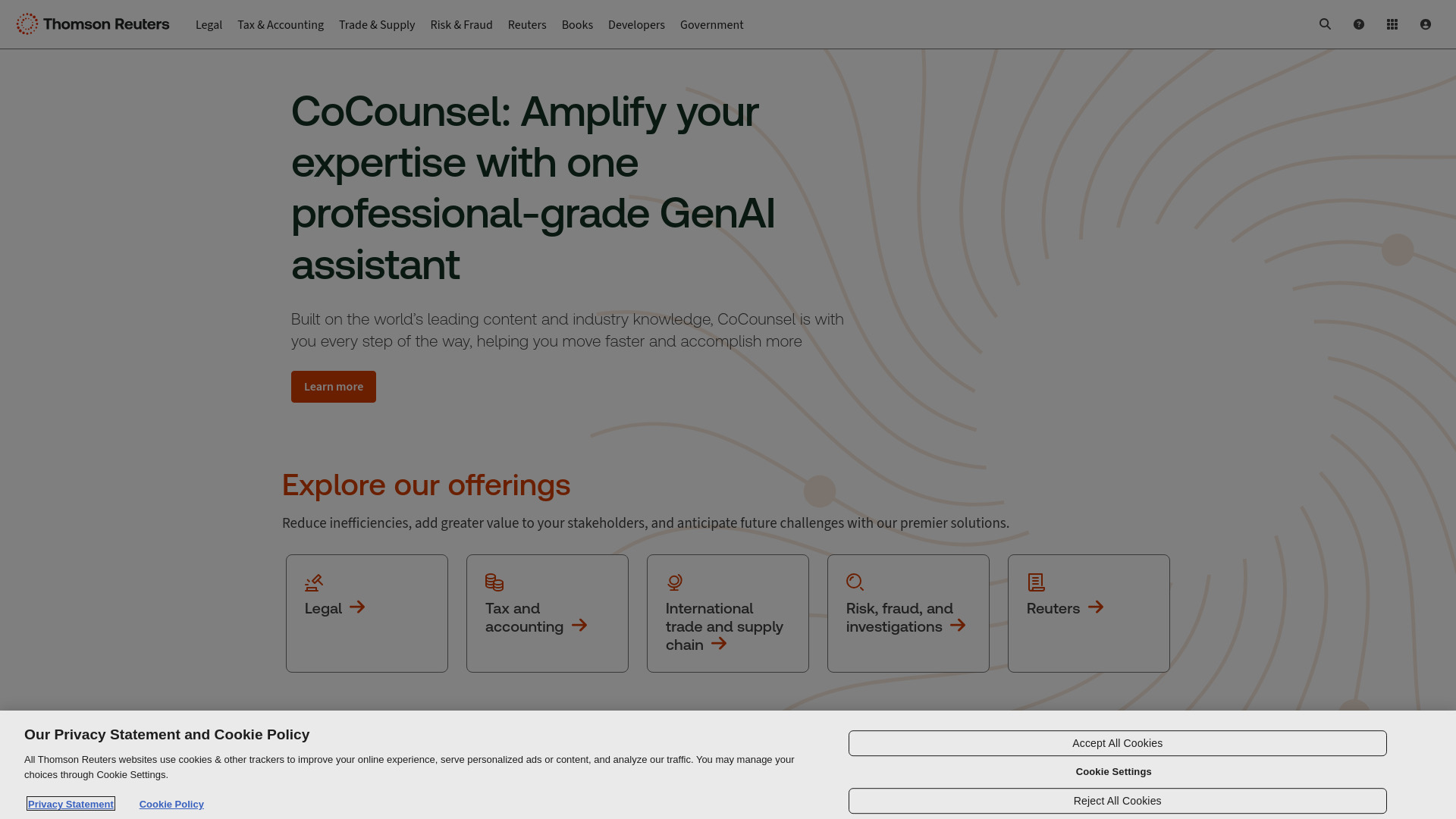
Thomson Reuters AI is a suite of domain-specific capabilities that combine trusted, authoritative content with modern machine learning to streamline professional work. Built for legal, tax and accounting, trade and supply, risk and fraud, and news and media teams, it helps users research faster, analyze documents, surface risks, and summarize complex information with citations. By embedding AI into familiar workflows, it reduces manual effort, strengthens compliance, and improves decision speed across highly regulated industries.
Thomson Reuters AI Key Features
- AI-powered legal research: Natural-language queries return relevant case law, statutes, and guidance with transparent citations and context.
- Document and contract analysis: Extracts clauses, flags risk language, compares versions, and accelerates drafting and review.
- Tax and accounting automation: Assists with classification, workpaper prep, issue identification, and change tracking across jurisdictions.
- Global trade compliance: Supports tariff classification, restricted party screening, and documentation checks to reduce shipment risk.
- Risk and fraud detection: Entity resolution, adverse media insights, and anomaly signals to aid KYC, AML, and investigative workflows.
- News summarization and insights: Condenses complex events, earnings, and regulatory updates to speed editorial and market analysis.
- Workflow integration: Embeds AI into research, drafting, review, and reporting tools, with APIs for system integration.
- Governance and auditability: Controls, logs, and source-grounded outputs to support defensible decisions and compliance.
Who Is Thomson Reuters AI For
Ideal for law firms, in-house legal teams, tax and accounting professionals, compliance and trade managers, risk and fraud analysts, corporate counsel, and newsrooms seeking faster research, reliable analysis, and auditable outputs within regulated, content-intensive workflows.
How to Use Thomson Reuters AI
- Select the product module aligned to your task (e.g., legal research, tax, trade, risk, or news workflows).
- Sign in and set your matter, client, or project context, including jurisdictions or regions.
- Enter a question, upload documents, or define a workflow step (research, review, summarize, compare).
- Refine prompts with relevant facts, dates, entities, and desired output format.
- Review results with citations, key passages, or flags; drill into sources as needed.
- Iterate, add constraints, and regenerate to improve precision and coverage.
- Export, share, or route outcomes into downstream systems with proper audit logs.
Thomson Reuters AI Industry Use Cases
A litigation team accelerates case law research and drafts argument sections with cited authorities. A multinational streamlines tariff classification and screening to prevent shipment delays. A financial institution enhances due diligence by surfacing adverse media and network risks. A newsroom summarizes earnings calls and regulatory filings to speed coverage while maintaining editorial standards.
Thomson Reuters AI Pricing
Pricing and packaging vary by product, features, user seats, and region. Offerings are typically subscription-based with enterprise licensing and optional add-ons. Prospective customers can request a demo or speak with sales to determine the best configuration for their needs.
Thomson Reuters AI Pros and Cons
Pros:
- Grounded in authoritative, domain-specific content with transparent citations.
- Meaningful productivity gains across research, drafting, and review workflows.
- Governance, audit trails, and controls suited to regulated environments.
- Broad coverage across legal, tax, trade, risk, and news use cases.
- Integration options to fit existing enterprise stacks and processes.
Cons:
- Enterprise licensing may be costly for small teams.
- Learning curve for prompt refinement and workflow configuration.
- Coverage and features can vary by jurisdiction and content availability.
- Dependence on proprietary data sources may limit portability.
Thomson Reuters AI FAQs
-
Does it provide citations to sources?
Yes. When applicable, outputs include citations or links to underlying source materials so users can verify and audit results.
-
How does it address accuracy and hallucinations?
It emphasizes retrieval from trusted content, clear citations, and user review workflows, helping professionals validate conclusions before action.
-
Can it integrate with existing systems?
Integration options and APIs are available in select products, enabling connection to research, document, and reporting tools.
-
Is it suitable for sensitive data?
Controls, permissions, and audit features are designed for regulated environments; organizations should configure policies to meet compliance needs.
-
What teams benefit most?
Legal, tax and accounting, trade compliance, risk and fraud, and news organizations seeking faster, verifiable insights benefit the most.