
- Home
- Prompt Engineering
- The Full Stack
The Full Stack
Open Website-
Tool Introduction:Full‑stack news, community, and courses to build and ship AI.
-
Inclusion Date:Nov 10, 2025
-
Social Media & Email:


Tool Information
What is The Full Stack AI
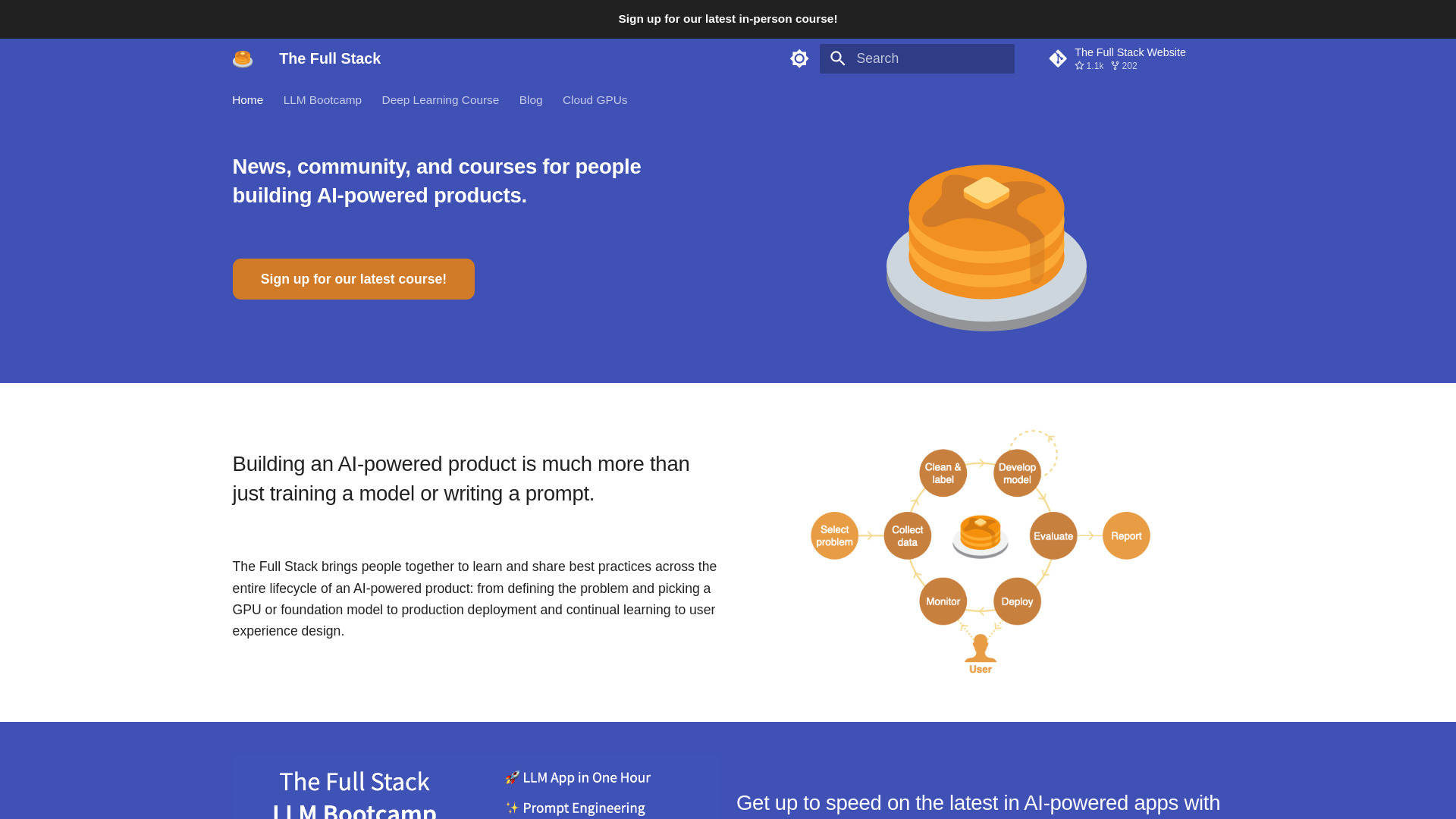
The Full Stack AI is a platform for builders who want to ship reliable, user-centered AI products. It spans the entire lifecycle of AI product development—problem definition, data strategy, GPU and infrastructure selection, LLM training or fine-tuning, evaluation, deployment, monitoring, continual learning, and UX design. Through curated news, an engaged community, and hands-on courses such as the LLM Bootcamp and Full Stack Deep Learning (FSDL), it teaches best practices and modern tools so teams can move from prototype to production with confidence and create real value with AI.
Main Features of The Full Stack AI
- End-to-end curriculum: Covers problem framing, data pipelines, prompt engineering, RAG, model training and fine-tuning, evaluation, safety, privacy, deployment, and observability.
- LLM Bootcamp: Practical projects for building LLM apps, including retrieval, evaluation harnesses, and production serving patterns.
- Full Stack Deep Learning (FSDL): Production-grade ML and MLOps patterns with code examples and implementation guidance.
- News and analysis: Curated updates on tools, frameworks, GPUs, and case studies to stay current with the AI ecosystem.
- Community for practitioners: Peer discussions, feedback, and support to accelerate learning and problem-solving.
- Tooling guidance: Practical advice on GPU selection, cloud setup, vector databases, orchestration, and CI/CD for ML.
- Templates and starter kits: Reusable project structures and checklists to reduce time-to-production.
Who Can Use The Full Stack AI
The Full Stack AI serves software engineers, machine learning engineers, data scientists, product managers, startup founders, and UX designers who need to build, ship, and iterate AI features. it's useful for teams modernizing MLOps, individuals upskilling on LLMs, and organizations standardizing best practices for AI application design, deployment, and evaluation.
How to Use The Full Stack AI
- Join the community and subscribe to the news feed to track tools, frameworks, and case studies.
- Choose a learning path (e.g., LLM Bootcamp or FSDL) aligned with your goals and experience.
- Set up your environment: Python stack, GPUs or cloud instances, data sources, and required SDKs.
- Follow the modules and labs to build working prototypes with evaluation and observability baked in.
- Harden to production with deployment, monitoring, data pipelines, and continual learning workflows.
- Share progress in the community, gather feedback, and iterate on UX and model quality.
The Full Stack AI Use Cases
Teams use The Full Stack AI to launch LLM-powered copilots in SaaS, build retrieval-augmented search for knowledge bases, automate support with guardrails in customer service, create risk and fraud detection workflows in fintech, design clinical NLP pipelines in healthcare, and deploy personalization engines in e-commerce. The curriculum and community help translate prototypes into maintainable, monitored, and compliant production systems.
The Full Stack AI Pricing
The platform typically combines free and paid resources. Many articles, guides, and selected course materials are openly available, while cohort-based programs such as the LLM Bootcamp and certain components of FSDL are paid. Organizations may enroll teams for structured instruction, and individuals can access free content to get started before committing to a cohort.
Pros and Cons of The Full Stack AI
Pros:
- Comprehensive, end-to-end focus from problem definition to production.
- Hands-on, project-driven learning that mirrors real-world constraints.
- Up-to-date news and tool guidance to navigate a fast-moving ecosystem.
- Supportive practitioner community for feedback and troubleshooting.
- Tool-agnostic perspective with practical GPU and infrastructure advice.
Cons:
- Time-intensive; meaningful progress requires sustained practice.
- Advanced topics may be challenging for complete beginners.
- Hands-on labs can require GPUs or paid cloud resources.
- Cohort schedules may not align with every learner’s availability.
FAQs about The Full Stack AI
-
What topics are covered?
Core areas include data strategy, LLMs, RAG, evaluation, safety, deployment, monitoring, and continual learning.
-
Is it suitable for beginners?
Beginners can start with foundational materials, while intermediate and advanced users benefit from production-focused modules.
-
Do I need a GPU?
Many labs run on cloud GPUs or CPU-friendly setups, but training and benchmarking are faster with GPU access.
-
How is it different from generic MOOCs?
It emphasizes shipping real products with MLOps best practices, evaluation, and user experience—not just model training.
-
Are there projects or capstones?
Yes, courses include hands-on projects that integrate data, modeling, evaluation, and deployment.
-
Is there a community?
Yes, practitioners share feedback, discuss tools, and help troubleshoot real-world implementation issues.