
Windward
Open Website-
Tool Introduction:Maritime AI with real-time insights for trade, shipping, logistics.
-
Inclusion Date:Nov 09, 2025
-
Social Media & Email:


Tool Information
What is Windward AI
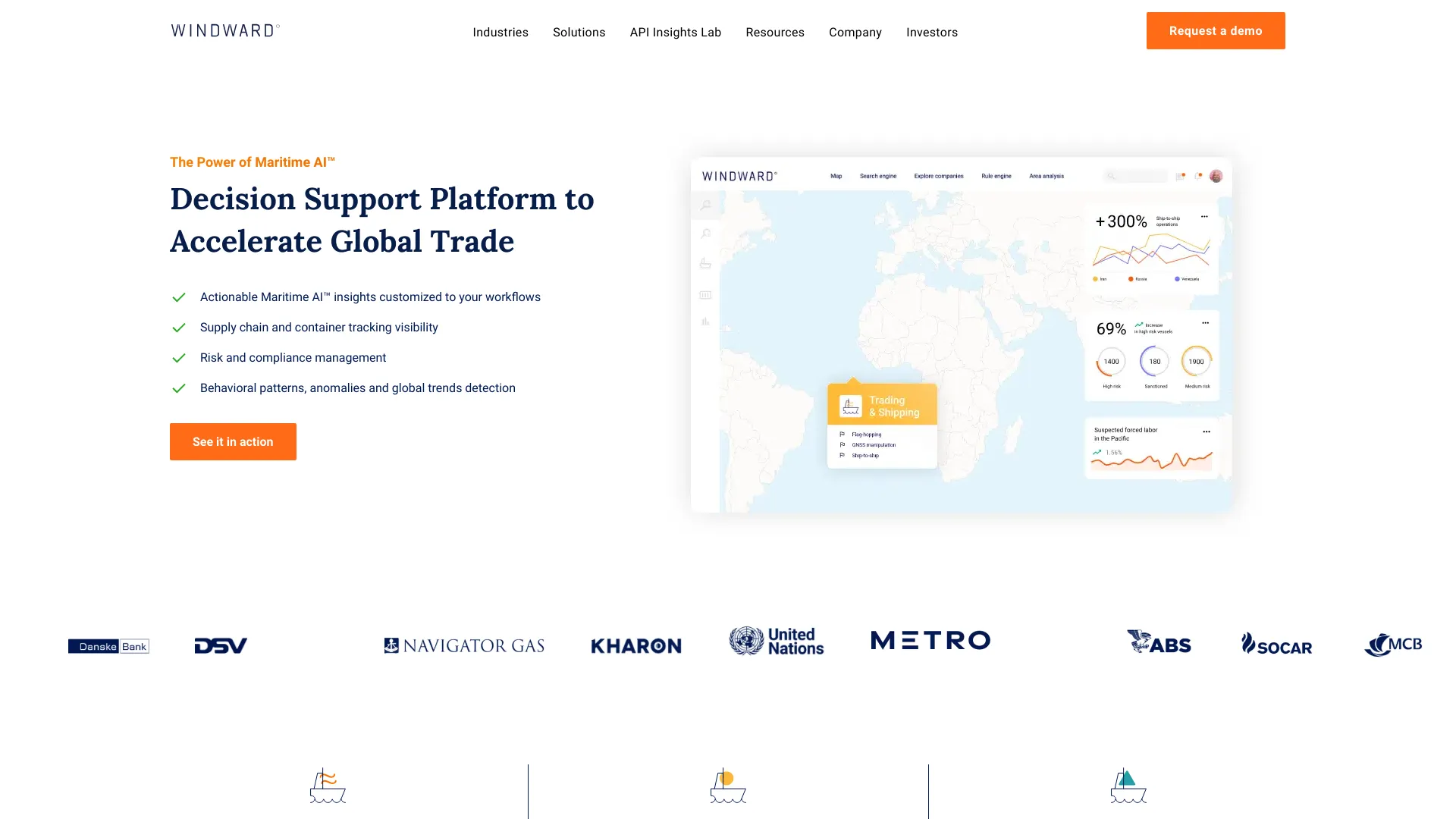
Windward AI is a maritime intelligence platform that turns global vessel signals and your unstructured data into structured, decision-ready insights. Built for trading, shipping, and logistics teams, it delivers real-time visibility and predictive analytics across fleets, ports, and routes. Users get a 360° view of the maritime ecosystem to assess voyage risk, monitor sanctions exposure, forecast ETAs and congestion, and automate compliance workflows—while detecting anomalous behavior like dark activity and ship-to-ship transfers to enable faster, evidence-based decisions.
Main Features of Windward AI
- Real-time maritime data fusion: Aggregates terrestrial and satellite AIS, port events, weather, and ownership data to create a unified operating picture.
- Predictive ETA and congestion analytics: Machine learning forecasts arrival times, dwell, and port congestion to optimize planning and reduce demurrage.
- Vessel behavior analytics: Detects dark activity, route deviations, and ship-to-ship (STS) transfers with explainable behavior models.
- Sanctions and compliance screening: Screens vessels and companies against watchlists, flags deceptive practices, and maps complex ownership structures.
- Risk scoring and due diligence: Provides voyage, vessel, and counterparty risk scores to support onboarding and continuous monitoring.
- Automated alerts and workflows: Configurable rules, watchlists, and case management streamline investigations and reporting.
- API and integrations: Delivers data and insights via API/webhooks to TMS, ERP, and supply chain platforms; supports SSO and audit trails.
- Custom dashboards: Interactive maps, timelines, and KPIs for fleet tracking, route analysis, and compliance oversight.
Who Can Use Windward AI
Windward AI serves commodity traders, shipowners and operators, freight forwarders, logistics and supply chain teams, marine insurers, banks and trade finance, compliance and risk managers, and port and terminal operators. Typical use cases include sanctions compliance, voyage risk assessment, ETA prediction, congestion monitoring, fraud and illicit shipping detection, and end-to-end supply chain visibility.
How to Use Windward AI
- Define objectives, such as sanctions screening, ETA optimization, or voyage risk monitoring.
- Onboard your data sources and user accounts; connect fleets, ports, and counterparties.
- Configure watchlists, risk thresholds, and alert rules for vessels, routes, and regions.
- Explore dashboards and maps to track voyages, ETAs, congestion, and behavioral signals.
- Screen vessels and companies for sanctions, ownership, and deceptive shipping practices.
- Use case management to document investigations and export reports for stakeholders.
- Integrate insights via API or data feeds into your TMS/ERP to automate workflows.
- Continuously monitor, refine rules, and review performance metrics to improve outcomes.
Windward AI Use Cases
Energy and commodities firms use Windward AI to detect dark activity and STS transfers when assessing tanker voyages. Logistics teams forecast ETAs and port congestion to schedule trucking and warehouse labor. Marine insurers enrich underwriting and claims with behavior-based risk scores. Banks and trade finance organizations screen vessels and counterparties to meet sanctions and AML requirements. Ports and terminals monitor traffic patterns to optimize berth allocation and reduce turnaround times.
Windward AI Pricing
Windward AI is typically offered as a subscription-based SaaS with modular packages (e.g., compliance, risk, and supply chain visibility), user seats, and data or API usage considerations. Pricing is customized by scope, data volume, and integration needs. Demos and tailored proposals are available by contacting the sales team.
Pros and Cons of Windward AI
Pros:
- Comprehensive 360° visibility across vessels, ports, routes, and counterparties.
- Accurate predictive analytics for ETA, congestion, and voyage risk.
- Robust sanctions screening and deceptive shipping detection.
- Automated alerts, watchlists, and case management streamline compliance.
- API access and integrations support scalable enterprise workflows.
- Global coverage with fused satellite and terrestrial AIS data.
Cons:
- Enterprise-grade pricing may be high for small teams.
- Advanced features can require a learning curve and process changes.
- Dependent on AIS and external data quality, which can vary by region.
- Integration and configuration may require IT resources.
FAQs about Windward AI
-
What data sources does Windward AI use?
It fuses terrestrial and satellite AIS, weather, port events, ownership and corporate registry data, regulatory lists, and customer data to produce structured maritime intelligence.
-
Can Windward AI detect dark activity and STS transfers?
Yes. Its behavior analytics identify AIS gaps, location spoofing patterns, and ship-to-ship transfer risk using contextual signals and historical behavior.
-
Does Windward AI integrate with existing systems?
Yes. Insights and alerts can be delivered via API and webhooks to TMS, ERP, and risk platforms, with audit trails and SSO support.
-
How accurate are ETA predictions?
ETAs are generated by machine learning models using live conditions and historical voyages. Accuracy varies by lane and congestion but is continuously recalibrated.
-
Is Windward AI suitable for smaller companies?
It is designed for mid-market and enterprise needs; smaller teams may benefit from targeted modules or data subscriptions depending on use case.