
- Home
- AI Healthcare
- Glass Health
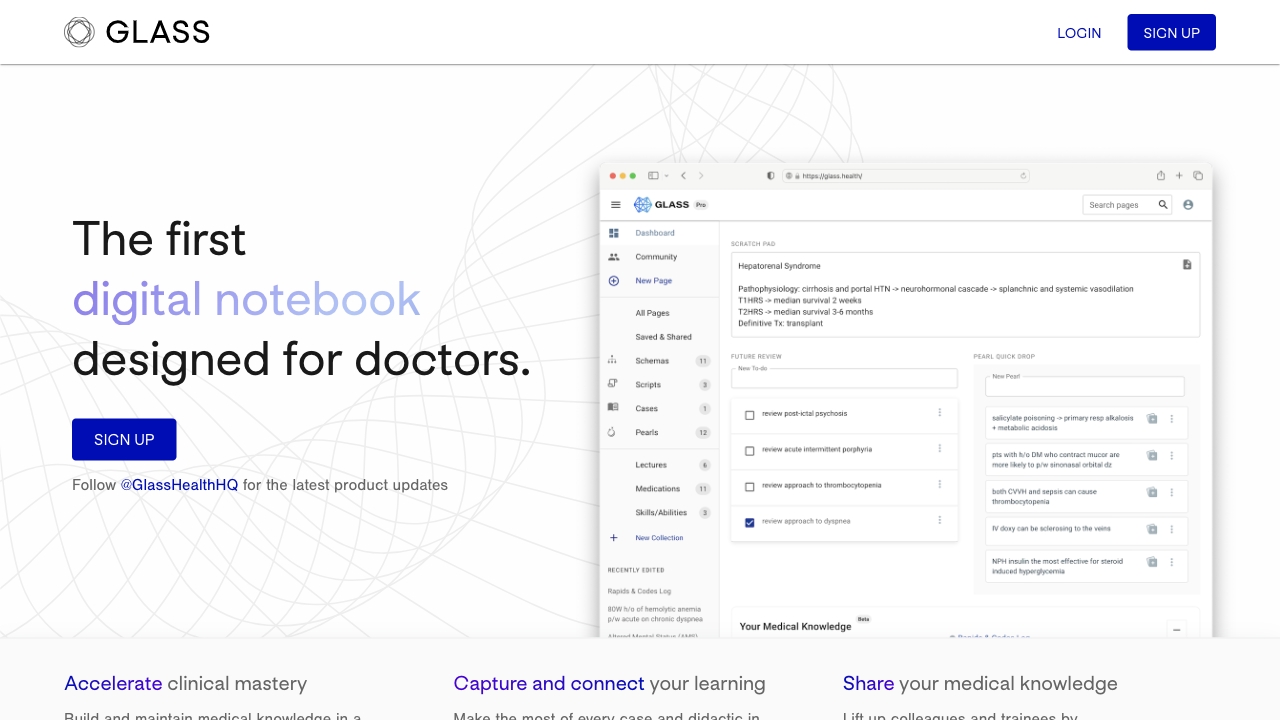
Glass Health
Open Website-
Tool Introduction:Clinical decision support that drafts differentials, A&P, and Q&A.
-
Inclusion Date:Nov 08, 2025
-
Social Media & Email:


Tool Information
What is Glass Health AI
Glass Health AI is an AI clinical decision support platform that helps clinicians organize thinking and speed up documentation. It drafts differential diagnoses, assessments and plans, and concise answers to clinical reference questions based on a patient’s presentation and clinician input. Designed to fit everyday workflow, it surfaces evidence‑informed suggestions while preserving clinician judgment and oversight. The platform focuses on text‑based medical reasoning and is not built to acquire, process, or analyze medical images, device signals, or patterns from signal acquisition systems.
Main Features of Glass Health AI
- Differential diagnosis generation: Produces ranked, explainable differentials aligned to symptoms, history, exam findings, and labs.
- Assessment & Plan drafts: Creates structured problem lists with suggested assessments, orders, follow‑up, and monitoring points.
- Clinical reference Q&A: Answers point‑of‑care questions with concise, evidence‑informed summaries and guideline context.
- Structured case entry: Guides clinicians to capture chief complaint, HPI, exam, and data in a reproducible format.
- Editable outputs: Fully reviewable and editable notes to fit local protocols and clinician preferences.
- Export-friendly notes: Copy or export drafts into existing documentation workflows and formats (e.g., SOAP/APSO).
- Team collaboration: Facilitate shared case review and knowledge sharing across care teams.
- Privacy-conscious design: Focus on text clinical reasoning; not intended for medical image or device signal analysis.
Who Can Use Glass Health AI
Glass Health AI supports physicians, nurse practitioners, physician assistants, residents, and medical students in outpatient clinics, hospitals, urgent care, and telemedicine. It aids rapid differential generation, structured assessments and plans, and point‑of‑care clinical reference. Educators can use it to teach clinical reasoning, while quality and safety teams can use structured drafts to standardize documentation and reduce variability.
How to Use Glass Health AI
- Create an account and choose the task: differential, assessment & plan, or clinical reference Q&A.
- Enter a concise case summary: chief complaint, pertinent history, exam findings, and available labs.
- Review the generated differential diagnosis, including reasoning and key distinguishing features.
- Refine with additional context (risk factors, comorbidities, red flags) to improve relevance.
- Generate an Assessment & Plan draft with problems, suggested orders, and follow‑up items.
- Consult the reference answer for guidelines and considerations; verify against trusted sources.
- Edit outputs to match institutional protocols and export or copy into your note.
- Use clinician judgment at every step; the tool does not analyze images or device signals.
Glass Health AI Use Cases
Primary care visits where time‑efficient differentials and A&P drafts support comprehensive notes; emergency and urgent care triage to quickly surface likely diagnoses and red flags; inpatient ward rounds to standardize problem lists and plans; specialty consults to structure reasoning for complex cases; medical education for case‑based learning and feedback; telemedicine encounters to streamline documentation while answering clinical reference questions.
Glass Health AI Pricing
Glass Health AI is typically offered on a subscription basis for individual clinicians and organizations, with options that scale for teams and enterprises. Features and seat counts vary by plan, and availability of trials or promotional tiers may change over time. For the most current plan details and any volume discounts, refer to the official Glass Health website.
Pros and Cons of Glass Health AI
Pros:
- Accelerates differential diagnosis creation and documentation.
- Produces structured, editable assessments and plans.
- Provides concise clinical reference answers at the point of care.
- Supports consistent, standardized notes across teams.
- Designed for text‑based reasoning, reducing scope creep into imaging or device signal analysis.
Cons:
- Requires expert oversight; outputs may need revision and local adaptation.
- Not intended for medical image or signal processing use cases.
- Integration depth with EHRs may vary by organization.
- Quality depends on completeness and clarity of clinical input.
FAQs about Glass Health AI
-
Is Glass Health AI a medical device?
No. It is a clinical decision support tool that assists clinicians and does not replace professional judgment.
-
Can it analyze imaging or device signals?
No. The platform is not designed to acquire, process, or analyze medical images or signals from diagnostic devices.
-
Does it replace clinician judgment?
No. Outputs are drafts and suggestions that must be reviewed, adapted, and approved by a qualified clinician.
-
What information should I provide for best results?
A clear chief complaint, pertinent positives/negatives, exam findings, and available labs help generate relevant differentials and plans.
-
Can I export notes to my workflow?
Yes. Drafts can be edited and exported or copied to fit existing documentation workflows.