
- Home
- AI Speech-to-Text
- Enterprise Voice AI
Enterprise Voice AI
Open Website-
Tool Introduction:Build enterprise voice apps with real-time STT, TTS, and agents.
-
Inclusion Date:Oct 21, 2025
-
Social Media & Email:


Tool Information
What is Enterprise Voice AI
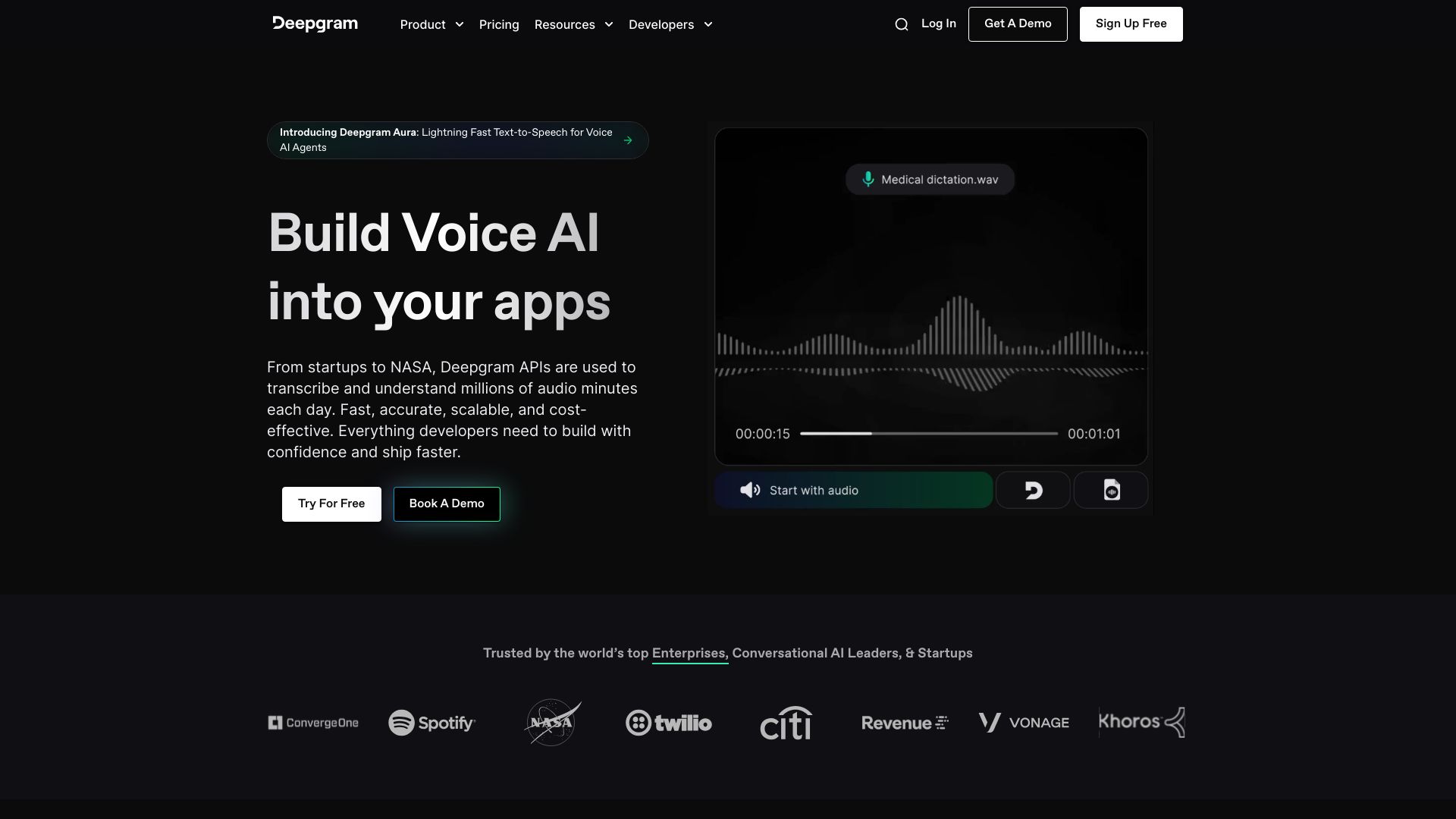
Enterprise Voice AI from Deepgram is a developer-first platform that delivers high-accuracy speech-to-text, natural text-to-speech, and programmable voice agent capabilities via simple APIs. It enables real-time, low-latency voice experiences on scalable, production-ready infrastructure. Teams use it to transcribe calls, power conversational AI, and synthesize lifelike speech in applications. With both streaming and batch workflows, it supports contact centers, medical transcription, and any operation that needs fast, reliable voice understanding at enterprise scale.
Enterprise Voice AI Main Features
- Real-time speech-to-text API: Low-latency streaming transcription with punctuation, word timestamps, and optional speaker separation for live calls and meetings.
- Batch transcription: High-accuracy processing for recorded audio and large archives, suitable for analytics and compliance workflows.
- Text-to-speech API: Natural, expressive speech generation to create lifelike voices for assistants, IVR, and product experiences.
- Voice agent tooling: Build responsive, full-duplex agents that listen and speak concurrently for smooth, human-like conversations.
- Scalable and reliable: Cloud-native architecture designed to handle enterprise traffic spikes and global workloads.
- Developer-friendly: Clear APIs, SDK options, and structured JSON responses that simplify integration and monitoring.
- Accuracy and robustness: Models tuned for real-world audio to handle accents, noise, and telephony-grade inputs.
- Insights-ready output: Confidence scores and timestamps to power downstream analytics, QA, and search.
Who Should Use Enterprise Voice AI
Enterprise Voice AI suits engineering and product teams building voice features, contact center operations seeking real-time transcription and agent assist, healthcare providers and medical scribing vendors doing clinical medical transcription, conversational AI and IVR builders, and SaaS platforms that need embedded speech-to-text, text-to-speech, or responsive voice agents at scale.
How to Use Enterprise Voice AI
- Create a Deepgram account and generate an API key with appropriate permissions.
- Choose your workflow: streaming or batch speech-to-text, text-to-speech, or a voice agent.
- Prepare audio or text: configure codecs, sample rates, and request parameters for your use case.
- Send requests to the API endpoint and handle structured JSON responses (transcripts or audio output).
- Integrate results into your app: display transcripts, trigger automations, or play synthesized speech.
- Test with real audio, measure latency and accuracy, then tune settings for production scale.
Enterprise Use Cases
- Contact centers: Real-time call transcription for agent assist, compliance, and quality assurance. - Healthcare: Clinical dictation and medical transcription workflows that feed EHR systems. - Conversational AI: Voice bots and IVR with low-latency turn-taking. - Media and productivity: Meeting notes, captions, and searchable archives for podcasts and videos.
Enterprise Voice AI Pros and Cons
Pros:
- High accuracy and low latency for real-time transcription and responses.
- Unified APIs for speech-to-text, text-to-speech, and voice agents.
- Scales to enterprise workloads with production reliability.
- Developer-centric tooling and structured outputs for analytics.
- Versatile across contact centers, healthcare, and conversational AI.
Cons:
- Requires careful tuning for domain-specific jargon and noisy environments.
- Ongoing usage costs can grow with high call volumes or long recordings.
- Network dependence and audio quality strongly affect performance.
- Compliance and data handling need to be validated for regulated industries.
Enterprise Voice AI FAQs
-
Question 1: Does it support real-time streaming transcription?
Yes. The streaming API delivers low-latency transcripts suitable for live calls, meetings, and agent assist.
-
Question 2: Can I build a full-duplex voice agent?
Yes. You can listen and speak concurrently to create natural, interruption-friendly conversations.
-
Question 3: What audio formats are supported?
It works with commonly used audio formats and telephony sample rates; choose configurations that match your capture pipeline.
-
Question 4: Is it suitable for medical transcription?
It is used for clinical dictation and medical workflows, though accuracy and compliance should be validated for your specific environment.