
- Home
- AI Developer Tools
- 昇思MindSpore
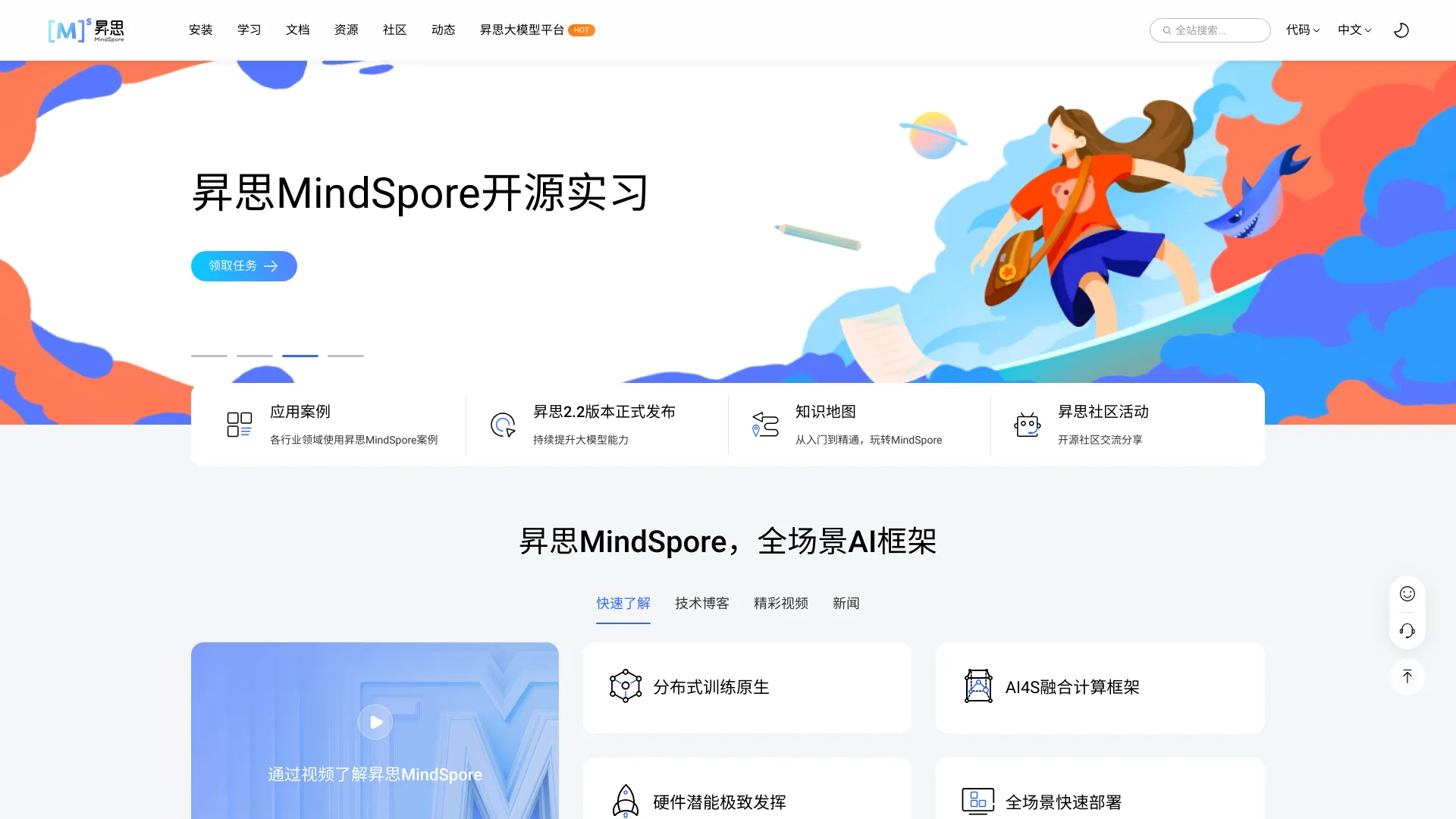
昇思MindSpore
Open Website-
Tool Introduction:MindSpore: open-source AI for edge/cloud/device; autodiff, distributed.
-
Inclusion Date:Nov 08, 2025
-
Social Media & Email:
Tool Information
What is 昇思MindSpore AI
昇思MindSpore AI is an open-source deep learning framework from Huawei built for full-scenario development across device, edge, and cloud. It provides source code transformation-based automatic differentiation, a high-performance graph execution engine, and flexible parallel training so teams can train once and deploy across multiple targets. Optimized for computer vision and natural language processing, it streamlines data pipelines, distributed training, and inference. A Python-first API and backends for CPU, GPU, and Ascend hardware help researchers and engineers build reliable, scalable AI systems.
Main Features of 昇思MindSpore AI
- Full-scenario support: Train and run inference consistently across device, edge, and cloud environments.
- Automatic differentiation: Source code transformation delivers efficient and accurate gradients for complex models.
- Flexible execution: Graph mode for performance and PyNative-style execution for iterative development.
- Distributed parallelism: Data, model, and pipeline parallel training with auto-parallel strategies.
- Graph execution engine: Operator fusion and optimization for high throughput and low latency.
- Data processing pipeline: Built-in dataset APIs and augmentation for scalable input pipelines.
- Edge deployment: MindSpore Lite enables lightweight, on-device inference for mobile and IoT.
- Ecosystem and tooling: Tutorials, examples, and community resources to accelerate development.
Who Can Use 昇思MindSpore AI
Designed for data scientists, machine learning engineers, and algorithm researchers, 昇思MindSpore AI fits teams building computer vision, NLP, and multimodal applications. It suits enterprises standardizing workflows from prototyping to production, as well as edge developers who need efficient on-device inference and consistent deployment across heterogeneous hardware.
How to Use 昇思MindSpore AI
- Install the framework via pip or source and select your backend target (CPU, GPU, or Ascend).
- Configure the runtime context, choosing graph or dynamic execution and device settings.
- Prepare datasets using MindSpore’s dataset APIs, including batching, sharding, and augmentation.
- Define your network with MindSpore Cell modules and operators.
- Select loss functions, optimizers, and metrics; set callbacks for logging and checkpoints.
- Enable distributed training if needed and launch multi-device jobs.
- Train, evaluate, and export models (e.g., MindIR) for deployment with MindSpore Serving or Lite.
昇思MindSpore AI Use Cases
Teams use 昇思MindSpore AI for image classification, detection, and segmentation in smart manufacturing and autonomous systems; NLP tasks such as sentiment analysis, NER, and machine translation in finance and telecom; speech and audio modeling for assistants; and edge AI scenarios like quality inspection, retail analytics, and predictive maintenance on embedded and IoT devices.
昇思MindSpore AI Pricing
昇思MindSpore AI is open-source and free to use. You can develop, train, and deploy models without licensing fees. If you run workloads on cloud infrastructure or specialized hardware, standard compute and storage costs from your chosen provider apply.
Pros and Cons of 昇思MindSpore AI
Pros:
- Full-scenario workflow across device, edge, and cloud.
- Efficient automatic differentiation and graph optimization.
- Robust distributed training with auto-parallel strategies.
- Python-first API and solid data pipeline tools.
- Optimized backends for CPU, GPU, and Ascend hardware.
Cons:
- Smaller global ecosystem compared to some long-established frameworks.
- Learning curve for graph execution concepts and APIs.
- Peak performance may depend on specific hardware configurations.
- Migration from other frameworks can require code adaptation.
FAQs about 昇思MindSpore AI
-
What hardware does 昇思MindSpore AI support?
It supports CPU, GPU, and Ascend backends, enabling development on workstations, servers, and edge devices.
-
Is 昇思MindSpore AI suitable for beginners?
Yes. It offers clear APIs, examples, and tutorials, making it approachable while still powerful for advanced research.
-
Does it support distributed training?
Yes. It provides data, model, and pipeline parallel strategies with auto-parallel features for multi-device scaling.
-
Can I deploy models on mobile or IoT devices?
Yes. MindSpore Lite enables lightweight inference on resource-constrained devices for on-device AI.
-
What is the license for 昇思MindSpore AI?
The framework is open-source, released under a permissive license suitable for commercial and research use.