
- Home
- AI Developer Tools
- Agno
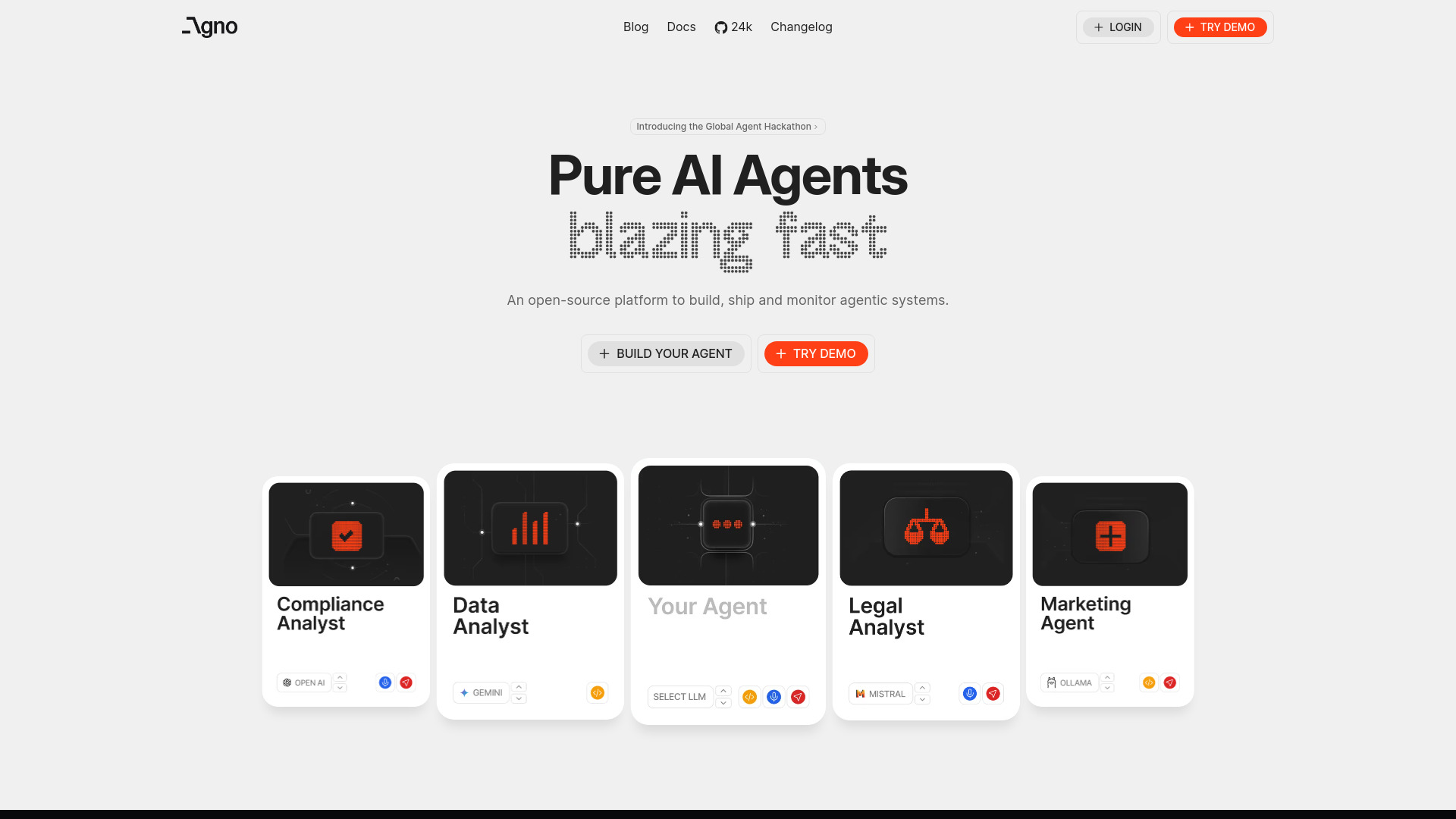
Agno
Open Website-
Tool Introduction:Open-source, model-agnostic stack for fast multimodal AI agents with memory.
-
Inclusion Date:Nov 08, 2025
-
Social Media & Email:


Tool Information
What is Agno AI
Agno AI is an open-source library for building lightning-fast, model-agnostic, multimodal AI agents. It lets developers add memory, domain knowledge, tool use, and structured reasoning to create robust, production-ready assistants. Lightweight yet extensible, Agno AI helps teams build, ship, and monitor agentic systems across providers and modalities without lock-in. With a clean API and built-in observability, it speeds up prototyping while keeping deployments future-proof. Support for streaming, async workflows, and reusable components delivers high performance at scale.
Main Features of Agno AI
- Model-agnostic architecture: Swap between different language and vision models without code rewrites, avoiding vendor lock-in.
- Multimodal I/O: Build agents that understand and generate across text, images, and other modalities for richer user interactions.
- Memory and knowledge integration: Add short- and long-term memory, retrieval, and knowledge sources to ground responses and improve continuity.
- Tool use and automation: Connect external APIs, databases, and functions so agents can take actions and complete end-to-end tasks.
- Reasoning and orchestration: Configure planning, stateful workflows, and agent handoffs to handle complex, multi-step processes.
- Observability and monitoring: Trace runs, inspect events, and capture metrics to debug, optimize, and ensure reliability in production.
- Performance at scale: Async execution, streaming, caching, and parallel calls for low latency and cost-efficient throughput.
- Extensible interfaces: Pluggable backends for memory, vector stores, tools, and transports to fit existing stacks.
- Deployment flexibility: Run locally, on servers, or in serverless/containerized environments using your own infrastructure.
Who Can Use Agno AI
Agno AI suits software engineers, ML/AI developers, data teams, and product squads building assistants, copilots, and automation. Startups can prototype rapidly, while enterprises can standardize agent frameworks across business units. it's also useful for research labs exploring multimodal reasoning, solution architects integrating RAG and tool use, and platform teams needing a future-proof, model-agnostic foundation.
How to Use Agno AI
- Install the open-source library from your preferred package manager and set up project credentials.
- Select a model provider and configure API keys or endpoints for text and/or multimodal inference.
- Define your agent: goals, constraints, input/output schema, and safety/guardrails.
- Attach memory and knowledge backends (e.g., vector search, retrieval) to ground responses.
- Register tools and functions the agent can call to read/write data or trigger external actions.
- Configure reasoning and orchestration: planning steps, workflows, and error handling.
- Enable observability to trace runs, log events, and collect performance metrics.
- Test locally with sample tasks, then deploy to your preferred runtime and monitor in production.
Agno AI Use Cases
Teams use Agno AI to power customer support copilots with retrieval and tool use, sales assistants that qualify leads and update CRMs, analytics agents that query data and generate summaries, and IT ops bots that triage incidents and call runbooks. In e-commerce, it drives multimodal product discovery; in media, it helps with content planning and asset tagging; in healthcare and finance operations, it supports documentation, routing, and compliance-friendly workflows.
Agno AI Pricing
The core library is open-source and free to use under its community license. You control hosting and costs, paying only for your chosen model providers, storage, and infrastructure. Some contributors may offer optional managed or enterprise services; check the official repository or documentation for details and updates.
Pros and Cons of Agno AI
Pros:
- Open-source, model-agnostic foundation with no vendor lock-in.
- Multimodal capability plus memory, tools, and reasoning in one framework.
- High performance with async, streaming, and parallel execution.
- Strong observability for debugging and reliability in production.
- Extensible interfaces for custom tools, stores, and deployment choices.
Cons:
- Requires engineering effort to design workflows and integrations.
- Operational responsibility: hosting, scaling, and security are on your team.
- Model behavior can vary across providers, necessitating evaluation and tuning.
- Learning curve for advanced orchestration and monitoring features.
FAQs about Agno AI
-
Is Agno AI really model-agnostic?
Yes. it's designed to work across multiple model providers and modalities so you can switch or combine models without lock-in.
-
Does it support retrieval and memory?
Agno AI provides interfaces for short- and long-term memory, as well as retrieval to ground agent outputs in your data.
-
Can I use it for production workloads?
Yes. It includes observability and orchestration features that help move from prototypes to reliable production agents.
-
What costs should I expect?
The library is free; your costs come from model APIs, storage, and compute in your chosen infrastructure.
-
Does it handle multimodal inputs?
Agno AI is built for multimodal agents, enabling workflows that mix text, images, and other modalities.